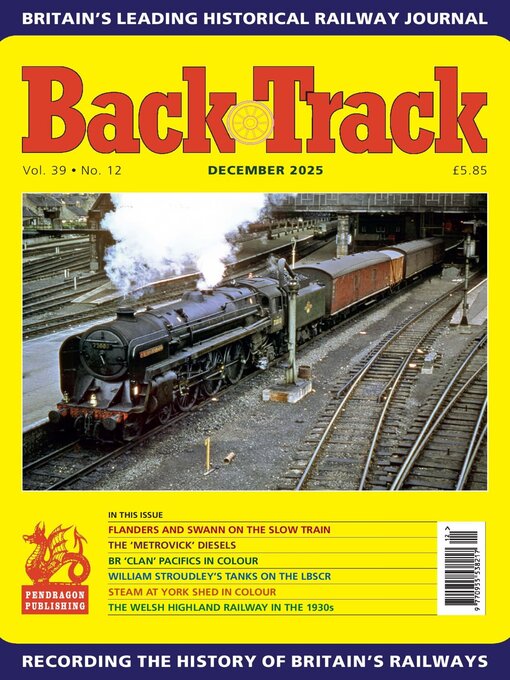
 Volume 40 No 5 - May 2026
 Volume 40 No 4 - April 2026
 Volume 40 No 3 - March 2026
 Volume 40 No 2 - February 2026
 Volume 40 No 1 - January 2026
 Volume 39 No 12 - December 2025
 Volume 39 No 11 - November 2025
 Volume 39 No 10 - October 2025
 Volume 39 No 9 - September 2025
 Volume 39 No 8 - August 2025
 Volume 39 No 7 - July 2025
 Volume 39 No 6 - June 2025
 Volume 39 No 5 - May 2025
 Volume 39 No 4 - April 2025
 Volume 39 No 3 - March 2025
 Volume 39 No 2 - February 2025
 Volume 39 No 1 - January 2025
 Volume 38 No 12 - December 2024
 Volume 38 No 11 - November 2024
 Volume 38 No 10 - October 2024
 Volume 38 No 9 - September 2024
 Volume 38 No 8 - August 2024
 Volume 38 No 7 - July 2024
 Volume 38 No 6 - June 2024
Backtrack, Britain's Leading Historical Railway Journal, covers all aspects of railway history from its earliest days through to more recent events up to around ten years before now including, early railway history from the 'pre-Stephenson' era, steam, diesel and electric locomotive history, railway company history, railway carriages and wagons, railway stations, railway ships, hotels & road vehicles, railway economic and social history, railway publicity and advertising. Backtrack's contributors include many of today's leading railway history writers. From the beginning the magazine has maintained a reputation for its production values and each issue contains a wealth of photographs reproduced to the highest standards, including a generous selection of historic colour. Published monthly, Backtrack is THE magazine for all who are interested in British railway history.
Editorial
ON SHED AT 50A • A variety of motive power at York locomotive depot photographed by GAVIN MORRISON
KILMARNOCK'S RAILWAYS TO 1922 PART TWO
A MIDSUMMER WEEKEND IN WALES IN 1968
WILLIAM STROUDLEY'S D TANKS ON THE BRIGHTON
CHEAP MUSIC, CLOSED STATIONS AND COMEDY GOLD FLANDERS & SWANN RIDING THE SLOW TRAIN
THOMAS HERD • The experiences of a Caledonian Railway track worker recounted by ALISTAIR F. NISBET
A ‘CLAN’ GATHERING • The ten Class 6 ‘Clan’ 4-6-2s built in 1951/2 as part of the British Railways Standard locomotive programme were in many respects a lesser verson of the ‘Britannia’ Pacifics, with a smaller boiler and firebox and a lighter axle loading, though with the same 6ft 2in diameter driving wheels. Their intended area of operation was in Scotland on routes where lower axle loadings were required. An order for a further fifteen (ten for Scotland and five for the Southern Region) was not proceeded with. While not the greatest of the Standard classes, the ‘Clans’ were competent enough and were arguably the best-looking of the BR tender locomotives.
THE METROVICKS GOOD INTENTIONS DISCARDED PART ONE
THIS WAY • Some lasting reminders on road signs of now-gone railways, photographed by NEIL TAYLOR
TIME WAS, ON THE WELSH HIGHLAND RAILWAY… • In a 1963 book P. B. Whitehouse wrote: “Perhaps it was the short life of the Welsh Highland which helped to give it such an aura of romance; certainly it must have been a rather wonderful railway…” The WHR was certainly that; but it had a short, disjointed and unsuccessful history. The North Wales Narrow Gauge Railway opened from Dinas Junction to South Snowdon in 1878, part of a wildly ambitious scheme for more lines in that area of North Wales; it then went bankrupt in 1879. What duly became the Welsh Highland Railway had extended it to Portmadoc by 1923 but despite being leased by the Festiniog Railway it lost money hand over fist, closing in 1937. The very idea that the WHR could ever be revived and reopened was unthinkable… and yet it has been! These photographs in the T. J. EDGINGTON COLLECTION date from its brief life as a ‘working’ railway.
THE RISE AND FALL OF THE ‘STONEBRIDGE RAILWAY’
HIGHLAND MIXTURE
THE CONFERENCE OF MOTIVE POWER OFFICERS PART ONE
Readers’ Forum • Letters intended for publication should ideally add extra detail to our articles (or offer corrections of course!) and not be too long, consistent with the detail they offer. As always, we are sorry that space and time prevent us from printing them all or sending personal replies. ED.
Book Reviews